
The Client: A Tire-and-Wheel Marketplace, Under NDA
The client is under NDA. We can't name them, and there's no link to the site — this case runs entirely on the artifacts we produced, not on a logo you can click through to.
What we can say: they were building an online marketplace for tires and wheels, entering a market where five established competitors already had catalogs running into the tens of thousands of listings. Automotive e-commerce, direct-to-consumer, launching into a category where the competition wasn't hypothetical — it was five specific websites you could open in five tabs.
The Problem: What Does Version One Actually Need?
The question the client brought us wasn't "how do we build a marketplace." It was harder than that: of everything those five competitors had built over years — filters, sort logic, product card layouts, homepage modules — what did version one actually need, and what could ship later, or not at all?
Guess wrong one way and the budget balloons before launch. Guess wrong the other way and you launch missing the one feature this category won't buy without. There was no shortcut around actually looking at what the competitors had.
The Result: A Product Another Team Built, and It's Live
The marketplace is live. Its own team built it — not us.
Here's what happened: we handed over a scope document that decided, feature by feature, what would ship in version one, what would sit collapsed in the prototype for later, and what wouldn't make it in at all. We handed over a working prototype and a finished UI design. We never gave a fixed price for the development itself — the client hadn't picked a build team when our part ended, and it turned out to be a team we never met.
That team built from our documents alone, and the product shipped. That's the real test of whether a scope and a set of designs are actually self-sufficient: not whether they work when the same agency carries them through to launch, but whether they work when someone else — no relationship to us, no context we could fill in on a call — picks them up cold.
How We Got There: Five Competitors, 180+ Features, One Scope
We mapped every competitor's functionality across three page types — homepage, catalog, product page — for five direct competitors: infoshina.com.ua, rezina.cc, ukrshina.com.ua, shiny-diski.com.ua, and autoshini.com. Over 180 features, tracked one row at a time: present or absent, competitor by competitor.
Every feature got a call, written down before anything went into design: ship it in version one, hold it collapsed in the prototype for later, or cut it from scope entirely. Filters narrowed from dozens of options down to the six that actually drive tire search — width, height, diameter, brand, season, price — with the rest deferred. Sorting stayed standard, on the logic that shoppers already know what "price low to high" means and don't need a new mental model to learn one. Product cards got trimmed to the numbers people actually decide on, not everything a database could show.
Separately, we looked at where the five competitors' traffic actually came from — organic against paid, channel mix, direct visits. All five sat at 20–30% direct traffic. In a fragmented category, that's a signal: people are typing in a name they already remember, not just searching "tires near me" and picking whoever ranks first. That shaped a recommendation for where the client should spend after launch, not just what to build before it.
The scope decisions became a clickable prototype — filters, sorting, card layouts, laid out the way the scope document called for.
We wrote the product's "About us" positioning copy and got it signed off.
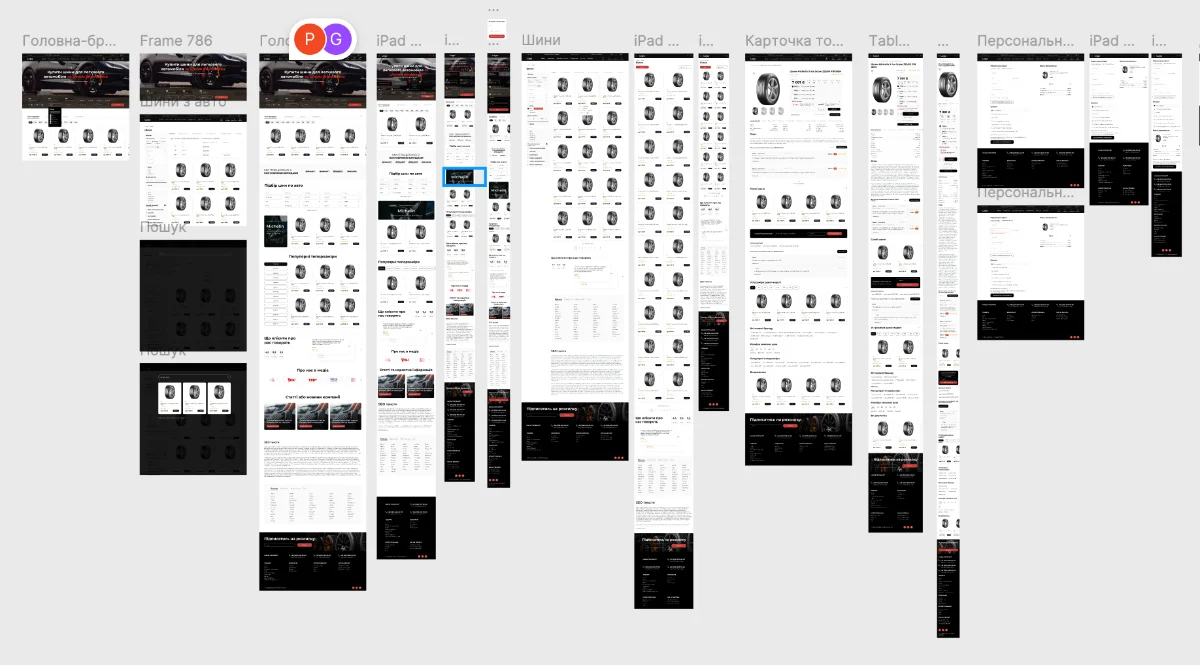
We designed the interface end to end and delivered it in Figma.
What the Client Got
A competitive audit of 180+ features across five marketplaces and three page types, with a ship-hold-cut decision on every one
A traffic and channel analysis of those same five competitors, with a conclusion about how the category earns customers after launch
A clickable prototype
Finalized "About us" positioning copy
A complete UI design, delivered in Figma
What This Proves
We didn't build this product. The client's own development team did — a team we scoped and designed for, but never worked with, never spoke to, never got on a call with.
That's usually the part of a story an agency leaves out. We're leading with it, because it's the strongest evidence we have for something we say everywhere else on this site: a scope document and a set of designs should be everything a dev team needs to build your product — whether that team is us or not. Here, it wasn't us. The product still shipped.
This predates the Scoping Sprint we run today. Back then it was two separate engagements — product scoping and UI design — without the fixed-price build quote, architecture outline, or refund guarantee that come packaged with the Sprint now. What carried over is the habit underneath it: decide what ships before anyone writes a line of code, and write the reasoning down.
If you're weighing whether to bring us in for the full build or just to get your idea properly scoped first, this case is your answer either way works.
See what the Scoping Sprint includes today →