


15 min read
A first order does not mean the customer will come back. A person can be happy with the product and still choose a different store next time — the one that sent a timely reminder, offered the right item or made checkout easier. That is why repeat sales in an online store need a process of their own: from collecting data (in Google Analytics 4, a CRM system and the store platform) to checking profit (in Google Sheets, Excel or a management accounting system with revenue and cost data).
A repeat sales system is the way you work with customers after their first order. The store keeps the purchase history, uses it to choose the product and the timing for the next offer, sets up the messages and checks whether they brought additional orders and profit.
You can start with one segment and one flow. For example, remind coffee buyers to restock if they have not placed a new order yet. After that the system grows in line with customer behaviour and test results.
A note for owners. Business owners should take part in choosing and approving the marketing strategy themselves, especially when they work with an outsourced marketing company. In practice this means joining the calls where the strategy is presented, asking questions and staying in direct contact with the agency team that will do the work. That way the owner hears the reasoning behind the recommendations from the specialists themselves and agrees the key decisions together with them. An in-house marketer may lack experience, and the wish to defend their own decision may get in the way of hearing what the agency recommends. The owner then receives only part of the arguments, and the business risks spending its budget on services that do not solve its problem.
What counts as a repeat sale
A repeat sale is a new order from a customer who has already bought from the store. They may buy the same item again, choose a different product or come back for a seasonal purchase.
An upsell inside the first basket increases its value but is not yet a repeat sale. An abandoned cart from a new visitor also belongs to a different stage: the first conversion. If the cart was left by an existing customer, bringing them back may well end in a repeat order.
Retention marketing covers the work of keeping customers: help after the purchase, product recommendations, loyalty programmes and winning back buyers who have not ordered for a long time. Repeat orders are one of the results of that work.
What retention is and how it differs in e-commerce
Retention means keeping customers: whether they keep using the product or buying after the first interaction. For an app this may be using the core feature again, for a subscription service renewing the subscription, for an online store the next successful order.
Retention can be assessed from different angles: whether a person uses the product, whether they buy a particular category, whether they come back to your store specifically and how the revenue from their purchases changes. Depending on the task, the team works with repeat orders, subscriptions, win-back campaigns or a loyalty programme.
Product retention is usually measured as a return to the core action after a set period of time. For example, how many new users came back to the service on day 7 or day 30. What counts is the action the person uses the service for, not merely logging in.
In e-commerce the cycle is different. Daily visits to the site are not required here. A customer may buy pet food once a month, cosmetics every few months or appliances every few years. So retention in an online store has to be assessed with the category, consumption period, seasonality, delivery and the real need for a new purchase in mind.
Repeat sales analysis distinguishes between the following terms:
- Repeat purchase — the customer has placed another successful order;
- Purchase frequency — how often they order within a given period;
- Reactivation — bringing a customer back after a longer gap than usual;
- Category retention — the customer keeps buying a certain type of product, even if they switch brand or specific item;
- Customer LTV — the accumulated or forecast revenue or contribution margin from a customer; the basis and period of the calculation have to be stated separately.
For example, if a customer bought a washing machine and did not come back for another one a year later, that does not necessarily mean the customer is lost. They may buy a care product, a filter or another appliance. But if a pet food buyer has not ordered a new pack by the expected date, that is already a signal worth checking: has their demand changed, was there a delivery problem, or did the store simply fail to remind them in time.
When you plan retention in e-commerce, work out when the customer will need the product again and what might get in the way of the order. A reminder will do little good if the item is out of stock, the cart is hard to complete or the store has not yet resolved a problem with the previous delivery.
Define a successful order in advance. For a store with cash on delivery, a submitted order and a collected parcel are different events. Cancellations, duplicates and returns must not inflate your numbers.

What a repeat sales system consists of
1. A single customer history
The store needs to see who bought, what exactly, when and with what outcome. This information can be collected in the e-commerce platform (WordPress with WooCommerce or OpenCart, for instance), a CRM or another agreed database (for analysing advertising channels, we at Guild of Marketing offer dashboards that bring together data from every connected channel: you can compare ad spend, the number of leads and enquiries, and see which channels deliver results).
The minimum set of data:
- a customer identifier and verified contact details;
- order identifiers, dates and statuses;
- products, categories, quantity and the amount after discounts;
- the date of delivery, cancellation and return;
- available channels and recorded consent for marketing messages;
- the date of the last message and its outcome.
To calculate profit, add cost of goods and variable expenses. To recommend products, add stock availability data.
Start by removing duplicates and aligning statuses. If a repeat purchase never reached the database, the system will keep reminding the person about a product they have already ordered. If two different customers have been merged by mistake, personalisation will be wrong as well.
2. Customer segmentation
A new customer may need help with the product, a regular one a reminder about the next order. Split the database into a few groups so you can choose the message for each of them.
Once you have enough history, you can add RFM analysis. It scores how recent the last purchase was (Recency), how often the customer buys (Frequency) and how much they spend (Monetary). That lets you single out those who buy often and spend a lot, and those who used to buy regularly but have not returned for a while.
Read RFM in the context of the category: a long gap between appliance purchases may be perfectly normal, while the same gap between pet food orders may signal a change in behaviour.
3. A reason for the next purchase
Before you launch a campaign, answer this: why does the customer need a new purchase right now, and specifically from you?
The reason may be running out of stock at home, a compatible accessory, a new season, a wanted item coming back in stock or the option to repeat a previous order quickly. A discount is only one of the options.
For a cosmetics store, the next step may be a product from the same line. For a pet shop, a repeat food order sized against the previous pack. For an electronics store, a tested compatible accessory.
Before launching an offer, calculate how much the store will earn on the order. Extra shipping, a gift and a promo code can make the order unprofitable even when open and conversion rates look convincing.
4. Automated flows
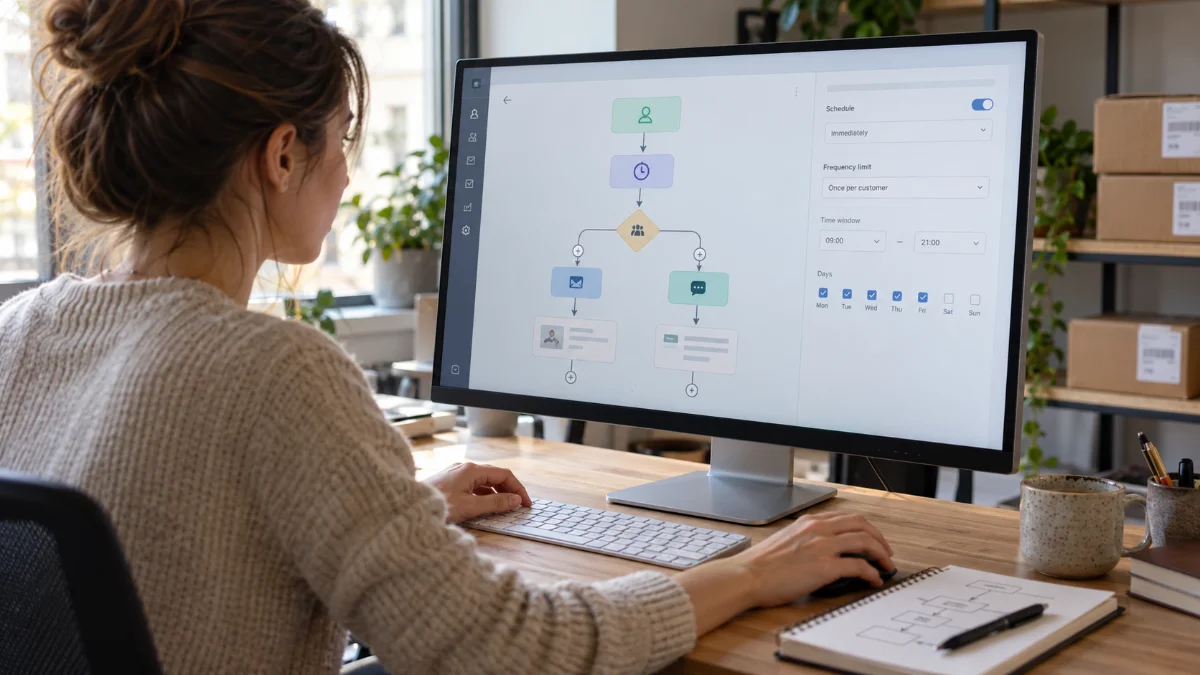
To automate repeat sales, define the trigger event, the conditions for sending the message and the conditions for stopping the flow.
For example: the customer received the coffee → the estimated consumption period has passed → there is no new order → the item is in stock → the customer may receive marketing messages → send a reminder.
After a new purchase the old sequence stops and the next cycle is calculated from scratch.
Automated flows can misfire, though, when their conditions are not aligned with each other. A customer may land in two funnels at once and start receiving messages too often. To avoid this, set entry and exit conditions for every flow, decide which one takes priority and put a shared frequency cap on marketing messages. Before each send, the system should check whether the customer has already bought and whether they have received another offer recently.
5. Channels and an easy repeat order
Email marketing for an online store works well for instructions, curated selections and recommendations. SMS or permitted messenger notifications can be tested for short reminders. Add a “Repeat order” button to the customer account so people can buy the product again without searching the catalogue.
Choose the channel by what contact details you have, what the customer prefers, what it costs and what it delivers. There is no need to push the same offer through every channel at once.
Check where the message leads. If the customer has to search for the product again, pick the familiar option and rebuild the cart, part of the value of the reminder is lost. The link should lead to the page of the product they need, or to a cart holding their previous order.
6. Service and an owner of the result
To retain online store customers, you have to deliver on what you promised during the first purchase: ship the product on time and help when something goes wrong. A customer still waiting for a parcel or a refund may simply ignore the next offer.
Put someone in charge of the system. The marketer runs segments, flows and tests; the technical specialist makes sure events are passed through; support keeps complaint and return statuses up to date; the manager watches costs and profit. In a small store one person may wear several of these hats, but responsibility still has to be assigned.
Invite customers to fill in a short feedback form after delivery, or send an SMS asking whether everything is fine with the purchase. That way the team learns about a problem in time, can reach out and offer a solution. When the complaint comes straight to the company, it is easier to clarify the details and help the person. An unresolved problem may later turn into a public review on Google Maps and affect how other buyers see you. Assign someone to process these replies and verify that the customer's issue has genuinely been resolved.
Which repeat sales flows to launch first
Start with the flow for which you already have reliable data and a clear customer need.
Timings have to be set from the products and the purchase history. A blanket rule of “send to everyone after 30 days” ignores pack size, consumption rate and seasonality.
Such flows are usually built on marketing platforms for email and SMS. Documentation for replenishment flows recommends relying on purchase history to work out the order cycle and pick a sensible moment for the reminder. Use the purchase history when configuring your chosen platform too.
Write a short card for each flow: goal, segment, trigger event, delay, channel, offer, exclusion rules and the primary metric. Agree an overall cap on marketing contacts so that different automations do not overwhelm one customer.
How to build a repeat sales system step by step
Take the order history over a period that covers several typical purchase cycles. Compare categories, the sources of the first order and groups of new customers by month.
Work out which products most often lead to a next order, how long that takes and after which products customers almost never buy again. Do not compare customers acquired last week with those who have had six months to buy again.
If the main problem is unfulfilled orders or frequent complaints, start with service. Messaging does not remove the cause of dissatisfaction.
For example: “A pet food replenishment reminder will increase the share of second purchases in this category within the chosen observation window.”
Record the current result, the criteria for including customers and the profit metric. If the store sells long-lasting goods, test a sensible companion product rather than a quick repurchase of the main item.
To start you need a source of orders, customer identification, an automation tool and reporting. These may be features of a single platform or of several integrated systems.
The store passes events and products; the CRM or database consolidates the history; the messaging service checks conditions and triggers the messages; analytics matches contacts against purchases and costs.
A separate CDP — a customer data platform — is not required for the first launch. It matters more that the tools you already have pass statuses correctly, do not duplicate events and stop flows on time.
Walk the customer journey from order to message. Check separately: a purchase before the send, a cancellation, a return, an unsubscribe, an out-of-stock item and a duplicated event.
These checks surface errors you cannot see in the email template: a wrong name, an outdated price, a duplicate message or an offer for an item that is not available.
Where possible, split eligible customers randomly into a test and a control group. The control group does not receive the marketing flow under study; transactional messages still go out.
Decide in advance how long you will observe, what the primary metric is and which other messages may affect both groups. Sample size depends on your baseline conversion and the effect you need to detect.
If the database is small, treat the result as an early signal. A before-and-after comparison is also useful for observation, but seasonality, advertising and assortment changes may explain part of the difference.
Add new categories, segments and channels once the basic flow runs reliably. Look not only at revenue but also at profit, returns, complaints and unsubscribes.
Which metrics show the result
To begin with, track six metrics. They will show whether customers come back, how their orders change and whether the store earns from this. For each metric, define the period and one consistent set of rules for counting completed orders, cancellations and returns.
All the figures in the table are illustrative — they explain the calculations and are not client results or market benchmarks.
To see what share of customers place several orders within the period; to compare categories and segments
To assess the move from the first purchase to the second and how flows for new customers perform
To track how regularly people buy and to pick segments for work on repeat demand
To choose when to send reminders and to compare cycles across categories
To assess the value of a repeat purchase, including after companion-product recommendations
To check the economics of the flow and compare it against the control group
Repeat purchase rate and second-purchase share answer different questions. A person may have bought for the first time at the end of a quarter and returned in the next one. Under the definition above they will not count as a two-order customer in the quarterly RPR, but their return will be captured by the 90-day second-purchase metric.
A cohort is a group of customers sharing a common trait, such as the month of their first purchase. For the 90-day metric, use only cohorts where the full observation window has already elapsed for every customer. The 90 days themselves are an example: choose the period to match the purchase cycle of your category.
Compare frequency and time to next purchase by category as well: pet food and a fridge have very different cycles. The median is the middle value in an ordered set of numbers. Time to second purchase is calculated only among those who returned, so a shorter time on its own does not prove that more customers are buying again.
LTV shows how much revenue or contribution margin a customer brings, or may bring, over the life of their relationship with the store. State the basis of the calculation, the period and the assumptions alongside the figure. For instance, average order value × number of purchases per year × expected years of the relationship gives a simplified revenue-based LTV. To estimate the contribution to profit you have to account for cost of goods and the related expenses. For a first test I would compare the actual profit contribution per customer over the same completed period, including in the calculation those group members who bought nothing. Count each cost item only once.
At the same time, watch returns, unsubscribes and complaints. If they go up, review how often you send, what the offers say and what is making customers unhappy. If you use churn rate, decide in advance how long without a purchase makes a customer inactive. NPS — the willingness to recommend the store — can round out the picture, but on its own it does not confirm repeat purchases.
An example of measuring incremental results
Consider a hypothetical example. In randomly formed groups of 500 customers each, a repeat purchase was made by:
- 75 people in the test group, or 15%;
- 60 people in the control group, or 12%.
The observed difference is 3 percentage points. Against the control group's 12% that is a 25% uplift. For the test group the difference amounts to roughly 15 additional buyers.
If each of those buyers placed one order contributing UAH 240 to profit after cost of goods, discounts and variable costs, and the flow cost an extra UAH 1,500, we get:
15 × 240 − 1,500 = UAH 2,100.
These numbers illustrate the logic of the calculation. They do not prove the effect is statistically reliable. In a real test it is better to compare the total profit contribution per customer across both groups, counting all their purchases, returns and costs.
What online stores in Ukraine should take into account
For cash-on-delivery purchases, keep order placement, dispatch, collection and payment as separate events. Replenishment reminders are best tied to the actual collection date, where that data is available.
In examples and messages, use clear prices in hryvnias, the language the customer communicates in and your current delivery terms. Carrier data, from Nova Poshta or Ukrposhta for instance, can help confirm the status — provided the store has the relevant integration.
If deliveries to a particular region are delayed, pause the promotional flows that no longer fit. Do not invite someone to “order again” when they have not received the previous parcel.
City matters for segmentation when it changes the offer: pickup availability, assortment, delivery or a local service. Simply naming Kyiv, Lviv or Odesa in an email does not make it more useful.
Keep transactional messages separate from marketing ones. Record proper consent for promotional contact and provide a clear way to opt out. A phone number left for delivery should not automatically be treated as consent for every promotional channel.
Mistakes that hold repeat sales back
First check whether convenience alone brings the customer back: a reminder, stock availability or a quick way to repeat the cart.
Some customers would have bought without the message. An attribution report is useful, but incremental impact is better measured with a control test.
Pet food, perfume and home appliances follow very different logics for the next purchase.
A new purchase, an unsubscribe, a return or a complaint should change what you send next.
Check whether members started buying more often and whether the extra profit covers the cost of the rewards.
If order statuses update late, more flows will simply produce more mistakes.
The first launch plan
The outline plan below suits a store that already has access to its order history and integrations. It is a schedule for organising the work, not a promise of a financial result within a month.
Judge the outcome once a typical purchase cycle and your chosen observation window have passed. For some categories that will take longer than setting the system up.
For the first launch, write down three things: who should come back, why the next purchase makes sense for them, and how you will verify the additional profit. Those answers will determine both the tools you need and what the messages say.
FAQ
Identify the products with potential for a next purchase, consolidate your customer history and launch a suitable flow after the first order. Measure the repeat purchase rate and the incremental profit contribution, not just message opens.
A separate CRM is not essential if your current platform already keeps a reliable customer history, passes the events you need and supports automation. A CRM helps when you have to bring together orders, the work of sales staff and enquiries from different channels.
There is no universal figure. The result depends on the category, the consumption cycle, the age of the customer base and how the metric is defined. Compare groups of customers for whom the same amount of time has passed since their first order.
Yes — a customer may come back for a product they need or a compatible accessory with no discount at all. Try a reminder with a quick repeat-order option and check whether the number of purchases went up.
When the customer has exceeded the purchase interval typical for their segment. Define inactivity with the product, seasonality and previous behaviour in mind, not as one fixed period for the whole database.
Pick one category, clean up your customer history and set up a single flow with clear start and stop conditions. Add the next flows once the first one runs without errors and you have assessed its costs and profit.
Want your customers to come back more often?
If this article has convinced you that your store needs a repeat sales system, we will help you check the data, choose the first segment and flow, and calculate whether it pays off. Not campaigns for the sake of campaigns, but repeat orders you can measure.
Request a review

